

Why Is Dermatology Such a Competitive Specialty?
More people are seeking help from the dermatology field to help with various conditions, whether skin cancer or anti-aging treatments. Medical students looking into dermatology should understand how competitive dermatology residency is so they can take the appropriate steps to match into a residency program.
This article tells you what you need to know about the dermatology field, what you need to get into the field, why dermatology is an excellent specialty, the things you should consider if you’re considering dermatology and the steps you can take to get your license. You’ll also learn how you can get dermatology tutoring services to gain a competitive edge when applying for a dermatology residency.
What Is Dermatology?
Dermatology is a medical practice that focuses on treating conditions that affect the skin, nails and hair. Dermatology practices use both surgical and medical methods to assist with different needs. Dermatologists can also help with cosmetic concerns. Some of the conditions that dermatologists treat include:
-
Eczema
-
Skin cancer
-
Psoriasis
-
Acne scarring
-
Hair loss
-
Moles
-
Rosacea
-
Varicose veins
-
Wrinkles and fine lines
These are just a few of thousands of conditions that dermatologists treat. Dermatology can be a rewarding practice that allows you to save lives and improve patients’ quality of life. However, there are specific requirements students must meet to match into a dermatology residency program, and dermatology can be hard to get into. Learn more about the statistics below and what you need to match into a residency program.
Dermatology Match Statistics
Over the years, the number of dermatology spots has increased as the demand grew for more practicing dermatologists. However, the number of students who apply is still greater than the number of spots available, which means dermatology is extremely competitive. But how competitive is dermatology residency exactly? Between 2019 and 2022, only 30 spots were available each year.
If you want to apply for a dermatology residency, you’ll need:
-
Quality letters of recommendation
-
A personal statement from residency
-
Quality Dean’s Letter or Medical Student Performance Evaluation (MSPE)
You’ll also need a strong score on the United States Medical Licensing Examination (USMLE), particularly Steps 1 and 2.
If you have these items, you could be a good candidate for a dermatology residency training program. However, it’s essential to remember that dermatology can be hard to get into and requires long-term commitment and study to obtain your license.
What Percentage of Dermatology Applicants Match?
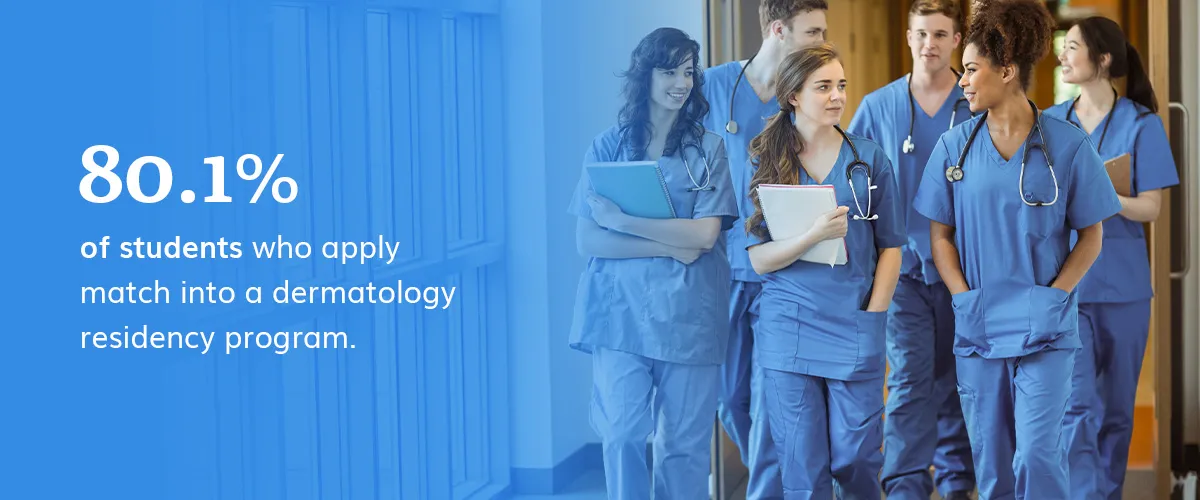
Dermatology is one of the more competitive medical specialties — about 80.1% of students who apply match into a dermatology residency program. If you’re considering dermatology, it’s essential to be aware of the competitive nature of the specialty. While you may not match into the program on the first try, more spots are becoming available each year as the market grows, and you can match into the program at another time.
How Many Dermatology Spots Are There?
Fewer students match into dermatology because there are a limited number of residency spots each year. Match data from 2017 shows that there were 423 spots available but 479 seniors. More students are looking to get into dermatology than there are spots available. However, more spots are expected to become available as the demand for dermatology continues to grow.
Average Step 1 and Step 2 Scores for Dermatology
Step 1 and 2 scores for dermatology are essential for getting a spot in residency since these scores help program directors quickly sort through applicants. Since dermatology is a competitive specialty, higher scores are crucial to getting a place in residency. The average score for Step 1 matched students is 249, which is considered above average. For Step 2, seniors who are matched into dermatology score an average of 256, which is considered an excellent score. This score allows students to choose from all specialties for potential matching, including dermatology.
Honors, Research and Awards for Dermatology Residency Candidates
Previous experiences, honors, research and awards increase residency candidates’ chances of matching into dermatology. Matched candidates had an average of 9.4 volunteer experiences when applying for residency. Additionally, residents who matched into dermatology have 5.8 research experiences and 3.7 work experiences.
Matched dermatology residents also had an average of 19 publications or presentations, making the need for publications from residency candidates very high.
International Medical Graduates (IMGs) Matching Into Dermatology
Dermatology is already a competitive specialty for students in the United States, and there are limited spots for these graduates. Dermatology doesn’t often accept IMGs, especially considering the rate they accept American students. However, it’s still possible for international students to become dermatologists in the United States with the right level of dedication.
Osteopathic (DO) Students Matching Into Dermatology
DO students who attempt to match into dermatology do so at a low percentage. In 2022, 40 DO seniors applied for a dermatology residency. Only three of those students matched, which doesn’t make dermatology a particularly friendly field for osteopathic students. However, it’s still possible to become a dermatologist if you’re an osteopathic student, as long as you do the work.

Should You Become a Dermatologist?
Dermatology can be a lucrative career choice as the market continues to see steady growth, but is dermatology worth it? If you’re considering becoming an officially certified dermatologist, first consider what you should know before taking steps to enter the field:
-
You don’t need an undergrad degree in science to be a dermatologist: If you spent your undergrad studying something other than science, you could still become a dermatologist. Education in psychology, anthropology and even art can give you a unique perspective when working in cosmetic dermatology. However, you’ll still need to take specific prerequisite courses to get into medical school.
-
You don’t need to declare your interest in medical school immediately: When you first get to medical school, you may want to specialize in something other than dermatology. If you’re in the middle of med school, you can still switch to dermatology if you find that your current specialty isn’t holding your interest.
-
Background research can make you a better dermatologist: Understanding how the body works and what may cause certain conditions will help you apply for a residency and work with patients. Research can help you stand out against the competition and make you a better dermatologist for your patients, allowing you to treat conditions at their root rather than providing a temporary solution.
-
It will take time to become certified: Becoming a medical professional takes years of schooling, which is still true for dermatologists. You’ll have to get a bachelor’s degree, apply for medical school, take numerous exams and complete your residency. With all the schooling, getting your certification can take 12 or more years.
-
It’s a competitive field: As we’ve stated before, dermatology is a competitive field, so you’ll have to work to stand out against the competition.
-
You may feel pressure regarding your own appearance: You may feel obligated always to have clear skin when you’re working as a dermatologist since you don’t want your patients to think that you can’t take care of your own skin. You may worry that if they think you can’t take care of your skin, they won’t trust you to take care of theirs.
-
People will consult you outside of work: Your friends and family may ask you to look at their skin problems outside of work, which you may or may not mind. Other times, your patients may approach you publicly, asking questions better suited to an office environment.
-
You’ll deal with more than breakouts: As a dermatologist, you’ll work with conditions related to acne breakouts, but you’ll also work with more. You’ll also work with other conditions, such as skin cancer, rosacea and psoriasis. Dermatology is a versatile field that will allow you to work with various conditions, providing you with valuable experience.
-
Things will still surprise you: There are many skin conditions, some rarer than others, and you’ll still be surprised by some of the things you’ll see. As a dermatologist and medical professional, you’ll need to refrain from showing your surprise, no matter how shocking something is.
-
You might have to deliver life-altering news: Sometimes, you’ll need to deliver bad news to patients as another doctor would. You may need to tell your patient that they’ve developed metastatic cancer or another type of life-changing condition. If you’re going into the dermatology field, you need to be aware that you may need to deliver news like this from time to time.
-
Your work can change lives: People seek out dermatologists for numerous reasons. You can help improve someone’s condition and confidence with your work, which can be a gratifying experience.
-
Psychology is a big part of dermatology: People’s mental health can significantly impact their skin conditions. Certain psychiatric disorders can also cause a person to develop different skin conditions, such as picking due to anxiety. Understanding psychology can help you more effectively treat your patients for their various conditions and deliver quality results.
Knowing what to expect and what you may have to deal with can help you determine if dermatology is the right field for you. Consider the above before deciding to become a dermatologist.
How to Be a Dermatologist
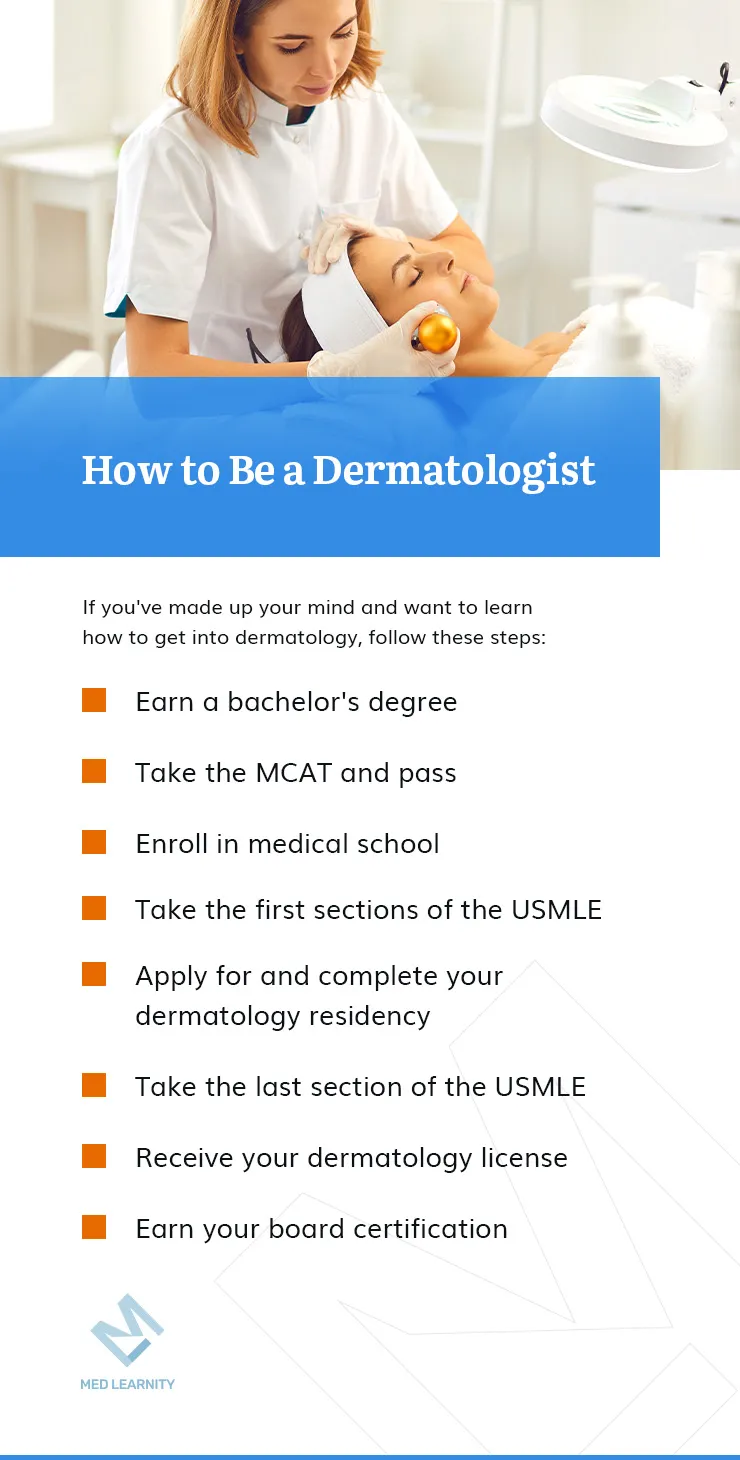
Dermatology can be a rewarding field since you’ll be helping patients improve their lives and making a sizeable income to help you further your practice. If you’ve made up your mind and want to learn how to get into dermatology, follow these steps:
-
Earn a bachelor’s degree: You’ll need to attend a four-year university or college first and get your bachelor’s degree before applying for medical school. You don’t necessarily need to get your degree in science like biology or chemistry, but it will certainly help when you start taking your courses in medical school. If you choose to major in something else, you’ll need to know what prerequisites you need to apply to medical school.
-
Take the MCAT and pass: First, you’ll need to take the Medical College Admissions Test (MCAT) to be admitted into medical school. This standardized test measures your critical thinking and problem-solving skills, as well as your knowledge of specific scientific concepts and analyzing abilities. These are all essential skills for medical professionals to possess. A higher score will also help you get into a better medical school.
-
Enroll in medical school: When looking for medical schools, you’ll want to choose options with a quality dermatology medical school program. Since the field is so competitive, you’ll want to select the best school possible, considering your MCAT scores and GPA. You can also see what percentage of students from each school were placed into residency.
-
Take the first sections of the USMLE: The United States Medical Licensing Examination (USMLE) is a test all prospective medical professionals must take to receive their official licensure. You’ll take the first two sections before your residency, and you need to do well since your scores will help you remain a competitor for a residency spot.
-
Apply for and complete your dermatology residency: There will be four main elements to your residency, which include letters of recommendation, a personal statement, a curriculum resume and a performance evaluation. Even if you don’t get accepted into dermatology residency the first time, don’t get discouraged. You can always apply again, and more spots will likely become available as the market grows.
-
Take the last section of the USMLE: You’ve already taken the first two sections of the USMLE. Now it’s time to complete the test so you can receive your dermatology license. A high dermatology USMLE score in the third section can offset any scores you’re unhappy with from the second section.
-
Receive your dermatology license: Once you’ve completed all steps of the USMLE and your residency, you can apply for your license. Research what’s required for your application based on the state where you want to work. You can also compare against other states if you haven’t decided where you want to practice.
-
Earn your board certification: Board certification will give you credibility and establish your commitment to dermatology. Once you go through the steps to become board certified, you’ll have to renew it every 10 years.
Getting your degrees, taking the exams, completing your residency and getting your license can take many years, meaning you’ll need to stay dedicated. However, the process becomes worth it once you can use your knowledge and skills to revolutionize people’s lives.

You may be at the very beginning of the process or deciding to change your specialty halfway through medical school. Regardless of when you choose to become a dermatologist, you can match into residency and earn your license at any stage. You can also receive tutoring if you need additional help with the course load and studying for your various exams. Tutoring from someone who has gone through the process can be a valuable tool to help you break into the competitive specialty.
About the Author – Randi Goldstein, MD
Randi Goldstein has been a dermatology resident since 2020 at LSU Health Sciences Center in New Orleans. She received her Doctor of Medicine from Mercer University School of Medicine and is now one of the top dermatologists in the country. Through hard work and volunteer experience during her time in medical school, Randi matched into dermatology on her first try. From the beginning of medical school, she knew she wanted to work in the dermatology field, allowing her to focus on her goal and successfully apply for residency.
While she notes that the process was challenging, she also says it was well worth the effort. Given her experience, she has much to offer prospective dermatology students applying for residency.
It may not be easy to be a dermatologist, but Medlearnity can help. If you’re considering dermatology and need a tutor, Medlearnity is here to help by pairing you with a quality tutor. We can help you identify and improve on any weaknesses to make the best impact. Our tutors have scored high on their own exams and are excellent educators. Sign up for your free trial today and meet your new tutor to get started!